

Events &
Presentations
The IMPROVE PRETERM team actively shares its work at international conferences, workshops, and community events. By presenting new insights and exchanging knowledge with researchers, healthcare professionals, and families, we help advance care for children and adults born very preterm.
This page highlights where our consortium members are representing the project – from scientific talks and poster sessions to stakeholder meetings and public engagement activities. Each event reflects our commitment to collaboration, transparency, and real-world impact.
DataSHIELD Conference – Liverpool, October 6-9, 2026
Expanding Secure Data Platforms for Preterm Research
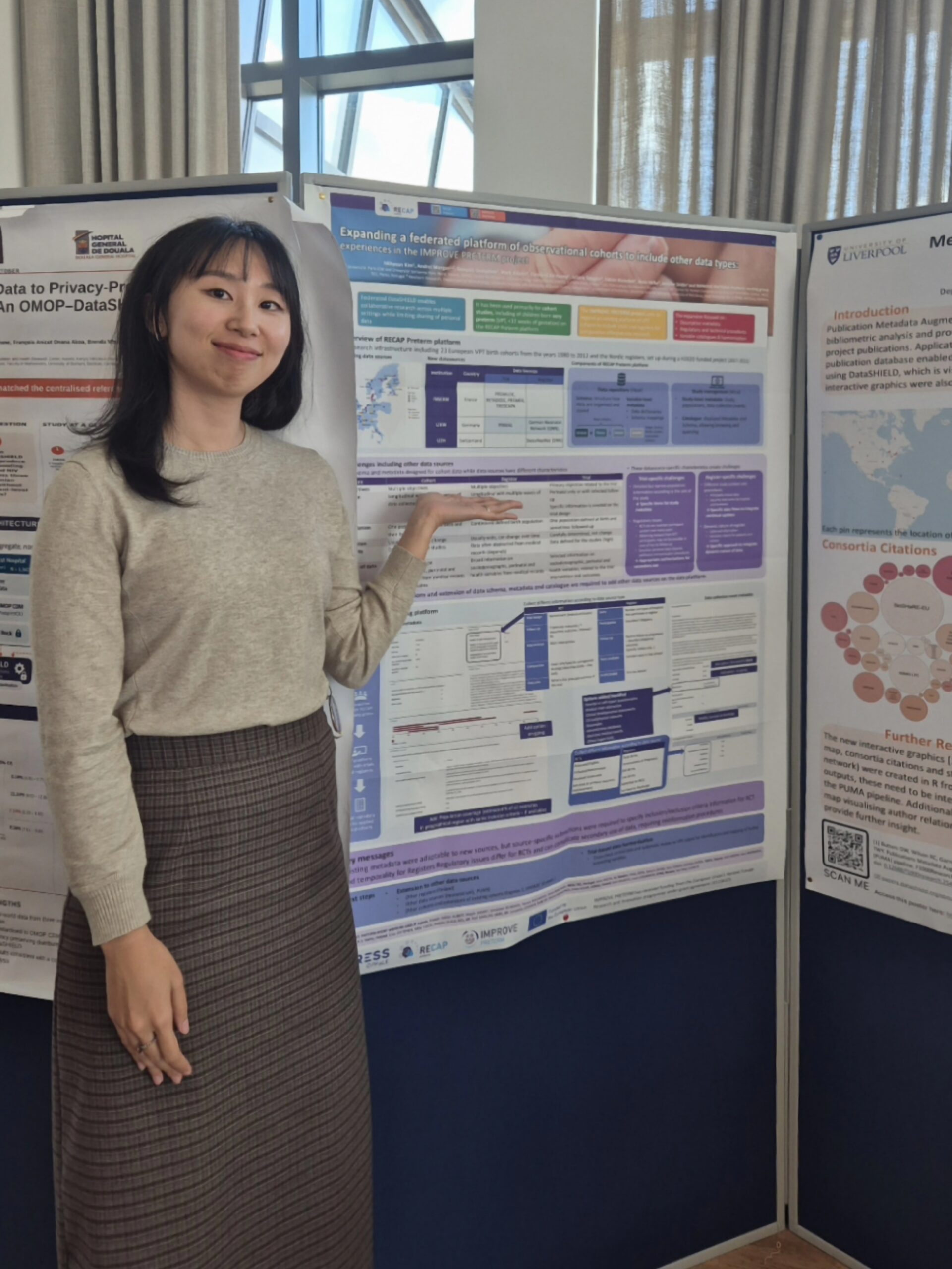
The DataSHIELD Conference 2026 brought together researchers, data scientists, and software developers to discuss secure, privacy-preserving approaches to analyzing health data. A particular focus was federated data analysis, which allows researchers to work with information from different institutions without bringing sensitive individual-level data together in one location.
Representing IMPROVE PRETERM, Mihyeon Kim presented a poster titled “Expanding a federated platform of observational cohorts to include other data types: experiences in the IMPROVE PRETERM project.” The poster highlighted work on expanding an existing research platform to accommodate additional types of data beyond observational cohorts. This contributes to IMPROVE PRETERM’s efforts to strengthen European research infrastructure and enable secure, collaborative studies on the long-term health and development of people born very preterm.
4th European Perinatal and Paediatric Epidemiology Conference (EPPEC) – Bristol, September 7-8, 2026
Investigating Antenatal Corticosteroid Timing in France
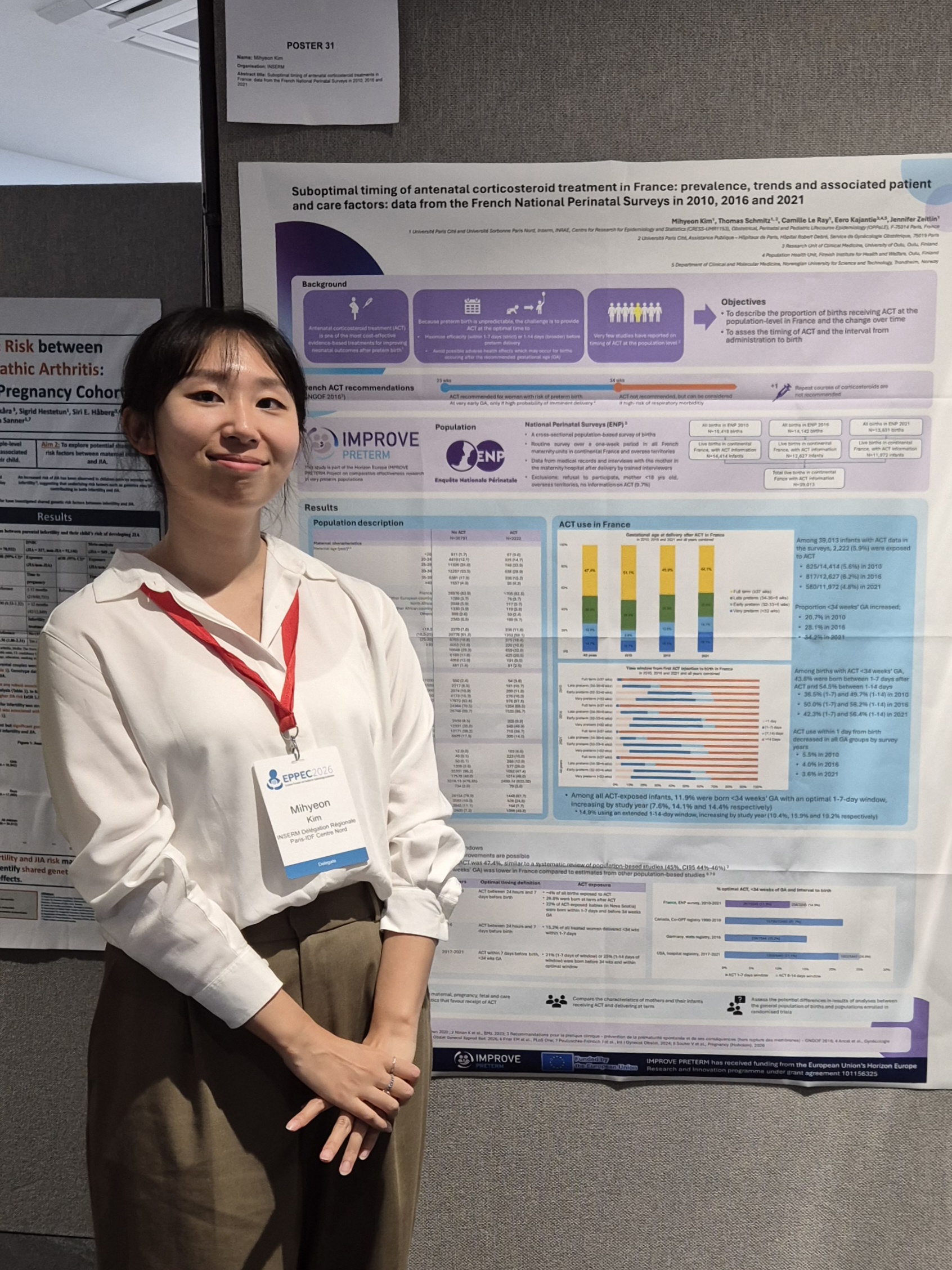
The 4th European Perinatal and Paediatric Epidemiology Conference (EPPEC) brought together researchers working in reproductive, perinatal, pediatric, and life-course epidemiology. The conference provided opportunities to exchange knowledge on maternal and child health, discuss new research findings, and explore methodological advances.
IMPROVE PRETERM researcher Mihyeon Kim presented a poster titled “Suboptimal timing of antenatal corticosteroid treatment in France: prevalence, trends and associated patient and care factors: data from the French National Perinatal Surveys in 2010, 2016 and 2021.” Drawing on nationwide survey data, the research examines patterns in the timing of antenatal corticosteroid treatment and factors associated with suboptimal timing. This work forms part of IMPROVE PRETERM’s broader investigation into corticosteroid use and how evidence can help improve care for babies at risk of very preterm birth.
6th Congress of joint European Neonatal Societies (jENS) – Belgrade, October 21-25, 2025
IMPROVE PRETERM at the 6th jENS

The IMPROVE PRETERM consortium took part in the 6th Congress of Joint European Neonatal Societies (jENS), one of Europe’s leading conferences for neonatal medicine. Partners shared new research and connected with clinicians, researchers, and parent representatives from across the continent.
Presentations included new findings on survival differences in extremely preterm infants and early work on comparing parental and clinical developmental assessments. These contributions highlight the project’s commitment to improving care and long-term outcomes for individuals born very preterm.
Investing in Child Health: For a Strong and Competitive European Future – Brussels, October 16, 2025
Strengthening Child Health Research Across Europe

INSERM hosted the conference “Investing in Child Health: For a Strong and Competitive European Future” at the Irène and Frédéric Joliot-Curie House in Brussels. The event brought together leading researchers, clinicians, and policymakers to address major challenges in pediatric health, including obesity, autism, and early puberty. Throughout the morning, experts shared the latest scientific evidence, discussed root causes and lifelong implications, and explored strategies to strengthen prevention, improve care pathways, and support children’s well-being across Europe.
As part of the program, Jennifer Zeitlin (INSERM) presented “Building a Federated Research Platform to Improve the Health Care of Children Born Preterm in Europe,” highlighting how the IMPROVE PRETERM project builds on existing European data infrastructures to advance research and improve long-term outcomes. Her talk underscored the importance of collaborative science and strong partnerships with policymakers to ensure that children born very preterm receive evidence-based care throughout childhood and beyond.
3rd European Perinatal and Paediatric Epidemiology Conference (EPPEC) – Oslo, September 15–16, 2025
IMPROVE PRETERM at EPPEC 2025
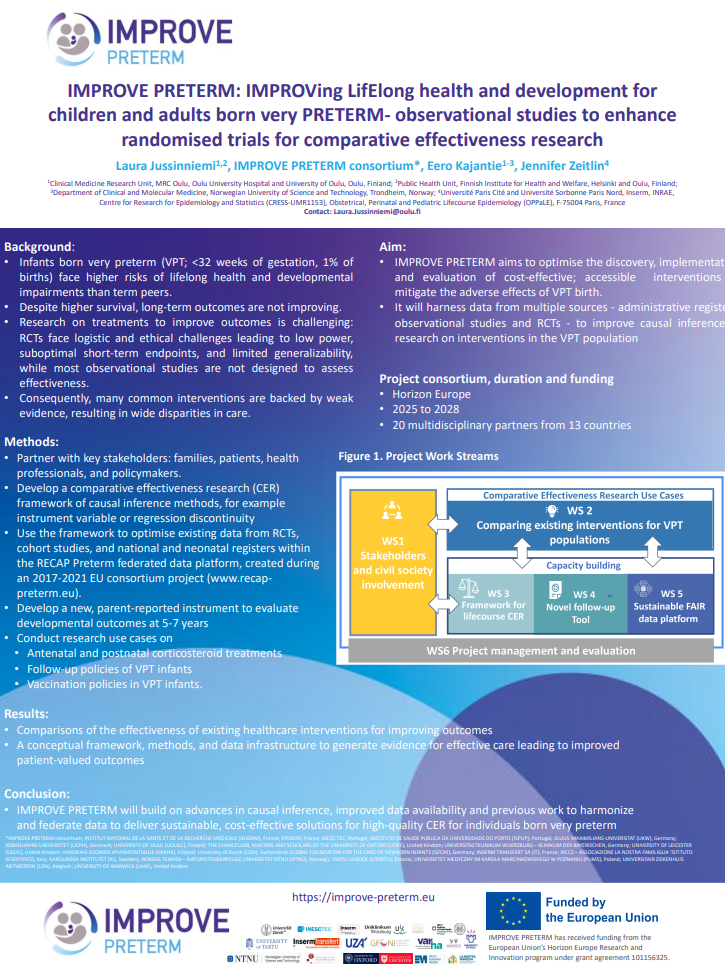
IMPROVE PRETERM consortium members participated in the 3rd European Perinatal and Paediatric Epidemiology Conference (EPPEC), held in Oslo on September 15-16, 2025. The conference brings together senior and junior researchers from across Europe and beyond who apply epidemiologic methods to reproduction, child health, and life-course research.
EPPEC aims to strengthen European collaboration in perinatal and pediatric epidemiology, foster exchange between clinical and epidemiologic research, and provide a platform for early-career researchers to present and discuss their work.
At the conference, Laura Jussinniemi (University of Oulu) presented a poster introducing the IMPROVE PRETERM project. The presentation outlined the consortium’s work to improve lifelong health and development for children and adults born very preterm by strengthening evidence on effective interventions, advancing comparative effectiveness research, and building on the RECAP Preterm platform.
Through its interdisciplinary approach and European collaboration, IMPROVE PRETERM contributes to advancing high-quality, evidence-based care for very preterm populations across the life course.
Kick-Off Meeting – Paris, May 12-13, 2025
Kicking Off the Project in Paris

The IMPROVE PRETERM project officially launched with a two-day kick-off meeting in Paris, hosted by the project coordinator INSERM. Representatives from all 20 partner institutions gathered to plan the first steps of this four-year European research initiative dedicated to improving lifelong health and development for children and adults born very preterm.
The meeting focused on refining scientific priorities, establishing governance and communication structures, and strengthening collaboration among researchers, clinicians, and family advocates. It also marked the start of the Parent & Patient Advisory Board (PPAB), ensuring that family perspectives are integrated into every stage of the project.